
GRAMMAR
Introduction to Japanese Particles
A fundamental guide to understanding how particles function in Japanese grammar.
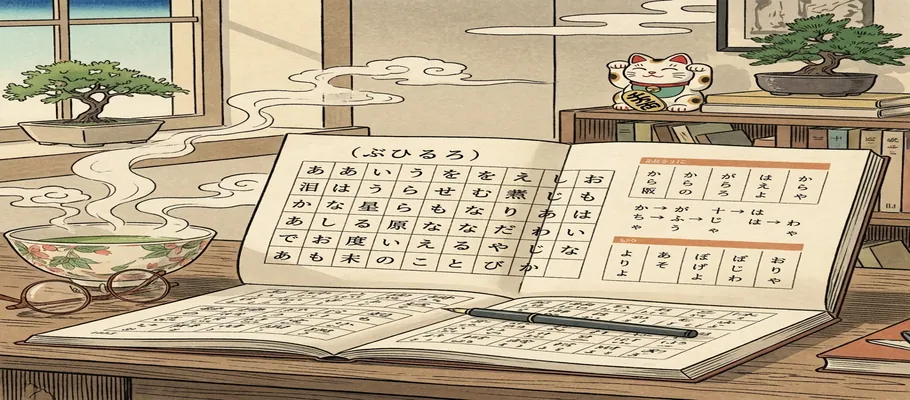
Hiragana is the primary phonetic script in Japanese and forms the foundation of The Japanese Writing System. It consists of 46 basic characters, each representing a single syllable or mora. Unlike Kanji, which represents meaning, hiragana is strictly phonetic.
While Katakana is primarily used for foreign loanwords, hiragana is used for native Japanese words. It is essential for writing grammatical particles, verb and adjective inflections (okurigana), and words that either lack kanji or have kanji that are too obscure for everyday use. Additionally, smaller hiragana characters called furigana are often written above or beside kanji to indicate their pronunciation.
The standard hiragana chart is known as the Gojūon (fifty sounds). It is organized by consonants and the five vowels: a, i, u, e, o.
Note: The character
| Row | a | i | u | e | o |
|---|---|---|---|---|---|
| Vowels | |||||
| K | |||||
| S | |||||
| T | |||||
| N | |||||
| H | |||||
| M | |||||
| Y | |||||
| R | |||||
| W/N | |||||
| n |
By adding two small markers to the top right of certain hiragana, the consonant sound changes.
| Row | a | i | u | e | o |
|---|---|---|---|---|---|
| G | |||||
| Z | |||||
| D | |||||
| B | |||||
| P |
Note:
Hiragana characters ending in the "i" sound can be combined with a small
| Row | ya | yu | yo |
|---|---|---|---|
| Ky- | |||
| Sh- | |||
| Ch- | |||
| Ny- | |||
| Hy- | |||
| My- | |||
| Ry- | |||
| Gy- | |||
| J- | |||
| By- | |||
| Py- |
A small "tsu" (
For example:
A fundamental guide to understanding how particles function in Japanese grammar.
Learn how to describe the world with い and な-adjectives by mastering their conjugations for tense and polarity to create rich, descriptive sentences.
Learn how to point out objects, places, and people using the Japanese demonstrative system, based on their distance from the speaker and listener.