
GRAMMAR
Introduction to Japanese Particles
A fundamental guide to understanding how particles function in Japanese grammar.
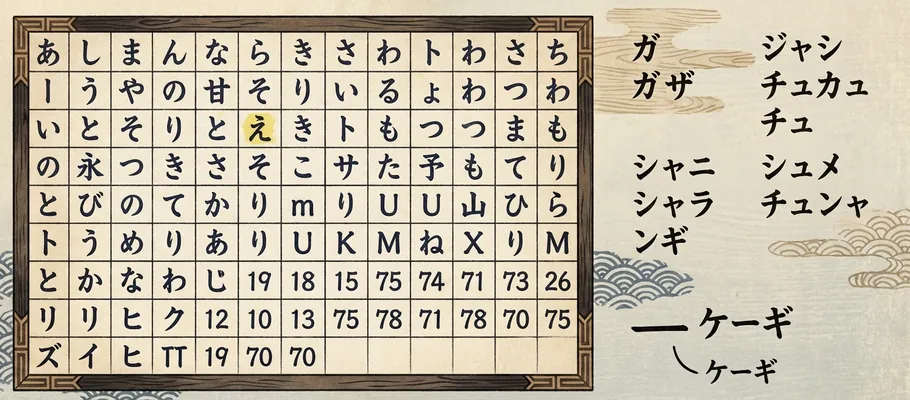
Katakana is the second phonetic script in The Japanese Writing System. Like Hiragana, it consists of 46 basic characters that represent the exact same sounds (syllables or moras). However, katakana characters are characterized by their sharp, angular strokes, contrasting with the cursive, flowing style of hiragana.
While hiragana is used for native Japanese words, katakana serves a different set of purposes. Its primary use is for writing foreign loanwords (gairaigo) and non-Japanese names. You will also see katakana used frequently for onomatopoeia (sound effects), scientific names of plants and animals, and for visual emphasis, similar to how italics are used in English.
The katakana chart mirrors the Gojūon structure used for hiragana. If you already know the sounds of hiragana, the pronunciation here is identical.
Note: The character
| Row | a | i | u | e | o |
|---|---|---|---|---|---|
| Vowels | |||||
| K | |||||
| S | |||||
| T | |||||
| N | |||||
| H | |||||
| M | |||||
| Y | |||||
| R | |||||
| W/N | |||||
| n |
Just like hiragana, katakana uses the dakuten (゛) to voice consonants (k → g, s → z, t → d, h → b) and the handakuten (゜) to change the H-row to a "p" sound.
| Row | a | i | u | e | o |
|---|---|---|---|---|---|
| G | |||||
| Z | |||||
| D | |||||
| B | |||||
| P |
Katakana ending in the "i" sound can be combined with a small
| Row | ya | yu | yo |
|---|---|---|---|
| Ky- | |||
| Sh- | |||
| Ch- | |||
| Ny- | |||
| Hy- | |||
| My- | |||
| Ry- | |||
| Gy- | |||
| J- | |||
| By- | |||
| Py- |
Because katakana is primarily used to adapt foreign words into Japanese, the standard 46 sounds are sometimes insufficient. To approximate non-native sounds (like "v", "fa", or "ti"), katakana utilizes unique combinations of base characters and smaller vowel characters (
Here are some of the most common extended combinations:
Katakana has a specific character used to denote long vowels, called a chōonpu. It looks like a straight line (ー) and simply extends the vowel sound of the preceding character. This is extremely common in loanwords.
For example, "coffee" is written as
Like hiragana, katakana uses a small "tsu" (
Once you are comfortable reading both katakana and hiragana, you possess the full phonetic toolset required to start learning Japanese vocabulary and reading basic texts before diving into Kanji.
A fundamental guide to understanding how particles function in Japanese grammar.
Learn how to describe the world with い and な-adjectives by mastering their conjugations for tense and polarity to create rich, descriptive sentences.
Learn how to point out objects, places, and people using the Japanese demonstrative system, based on their distance from the speaker and listener.