
GRAMMAR
Introduction to Japanese Particles
A fundamental guide to understanding how particles function in Japanese grammar.
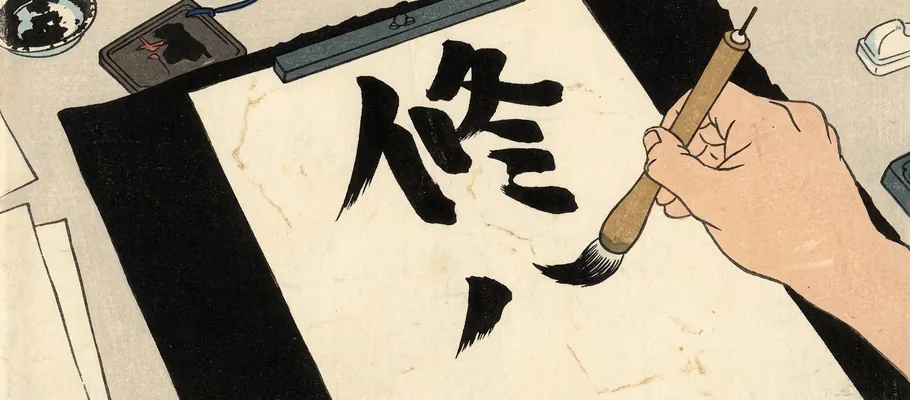
Modern Japanese uses a combination of three different scripts: Hiragana, Katakana, and Kanji. While the first two are phonetic alphabets where each character represents a single sound, Kanji are logographic. This means each character represents a specific concept or meaning.
In a standard Japanese sentence, Kanji are typically used for the core vocabulary, such as nouns, the stems of verbs, and adjectives. Because Japanese is written without spaces between words, Kanji play a crucial role in breaking up the text visually. They allow the reader to easily distinguish where one word ends and another begins. You can read more about how these scripts work together in our post on The Japanese Writing System.
While there are tens of thousands of Kanji in existence, you do not need to learn all of them to read Japanese. The Japanese Ministry of Education maintains a standard list called the Jōyō Kanji (Regular-Use Kanji).
This list contains 2,136 characters. These are the Kanji taught in Japanese schools and are sufficient to read newspapers, official documents, and most daily communications. Characters outside this list are generally accompanied by furigana (small Hiragana written above or next to the Kanji) to indicate how they should be pronounced.
One of the defining features of Kanji is that a single character usually has multiple pronunciations. When Kanji were imported from China to Japan over several centuries, the Japanese adopted the Chinese pronunciations alongside their own native words for those concepts.
This resulted in two main categories of readings, which you can explore in depth in our guide to On/Kun Readings:
For example, the character for "water" is
Another common example is the character for "mountain":
Kanji characters are not random collections of strokes. They are built from smaller, recurring components called radicals. There are 214 traditional radicals, and they often provide a structural hint about the character's general meaning or its pronunciation.
For instance, the "water" radical (氵) appears on the left side of many Kanji related to liquid or bodies of water:
Understanding radicals makes it easier to memorize complex characters, as you can break them down into recognizable parts rather than memorizing every single stroke.
Every Kanji has a strictly defined stroke order. This dictates the sequence and direction in which the lines of a character are drawn. The general rules for stroke order are to write from left to right, and from top to bottom.
Following the correct stroke order ensures that the character is balanced and well-proportioned. It also heavily influences the legibility of handwritten Japanese; when writing quickly, consecutive strokes often blend together into natural cursive forms that are only recognizable if the standard stroke order was followed.
A fundamental guide to understanding how particles function in Japanese grammar.
Learn how to describe the world with い and な-adjectives by mastering their conjugations for tense and polarity to create rich, descriptive sentences.
Learn how to point out objects, places, and people using the Japanese demonstrative system, based on their distance from the speaker and listener.