
GRAMMAR
Introduction to Japanese Particles
A fundamental guide to understanding how particles function in Japanese grammar.
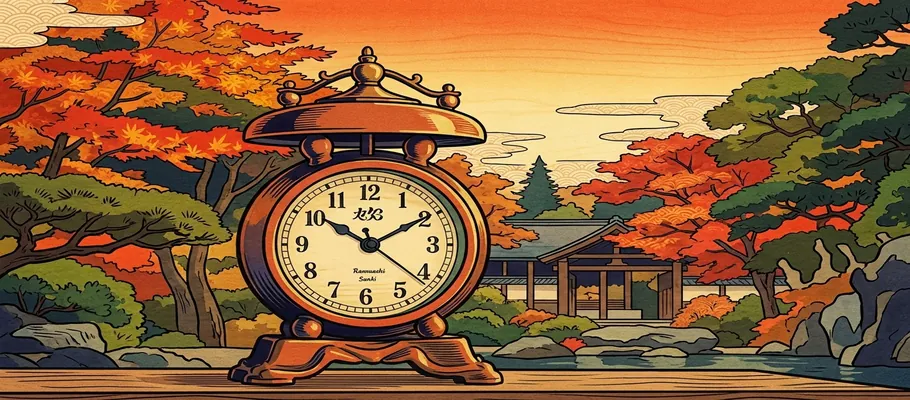
To read the clock in Japanese, you combine basic numbers with specific counter words for hours and minutes. The system is highly regular, though it requires memorizing a few phonetic changes.
Before starting, ensure you understand the basic numbers from 1 to 60. If you need a refresher, review the guide on Numbers in Japanese. Because expressing time relies on specific suffixes, it is also a practical introduction to Counting things in Japanese.
To express the hour, add the suffix
| Time | Reading | Kanji |
|---|---|---|
| 1:00 | 一時 | |
| 2:00 | 二時 | |
| 3:00 | 三時 | |
| 4:00 | 四時 | |
| 5:00 | 五時 | |
| 6:00 | 六時 | |
| 7:00 | 七時 | |
| 8:00 | 八時 | |
| 9:00 | 九時 | |
| 10:00 | 十時 | |
| 11:00 | 十一時 | |
| 12:00 | 十二時 |
Note: For 4:00, use
The counter for minutes is
Here are the first ten minutes. This pattern repeats for all subsequent numbers (e.g., 11 uses the same ending as 1, 20 uses the same ending as 10).
| Minute | Reading | Kanji |
|---|---|---|
| :01 | 一分 | |
| :02 | 二分 | |
| :03 | 三分 | |
| :04 | 四分 | |
| :05 | 五分 | |
| :06 | 六分 | |
| :07 | 七分 | |
| :08 | 八分 | |
| :09 | 九分 | |
| :10 | 十分 |
To say numbers past 10, simply stack the tens and the single digits.
For example, 15 minutes is
Instead of saying 30 minutes (
You add this directly after the hour.
For example, 4:30 is
Japanese specifies morning and afternoon using
Unlike English, where AM and PM are placed at the end of the time, in Japanese, these markers always go before the time.
To ask "What time is it now?" you use the word for "now" (
If you want to ask the time in a specific location, place the location first, followed by the particle
A fundamental guide to understanding how particles function in Japanese grammar.
Learn how to describe the world with い and な-adjectives by mastering their conjugations for tense and polarity to create rich, descriptive sentences.
Learn how to point out objects, places, and people using the Japanese demonstrative system, based on their distance from the speaker and listener.