

GRAMMAR
Introduction to Japanese Particles
A fundamental guide to understanding how particles function in Japanese grammar.
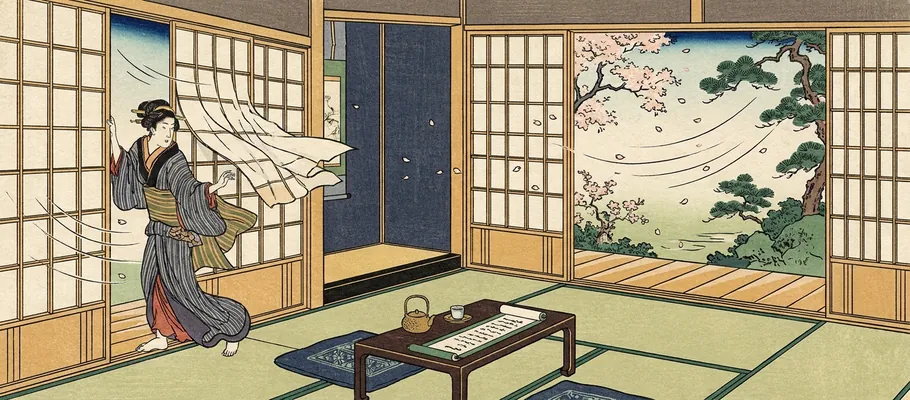
In Japanese, verbs are often divided into two categories based on how the action happens: Transitive Verbs
In English, we often use the exact same verb for both situations. You can say "I broke the cup" and "The cup broke." In Japanese, however, these are completely different, albeit closely related, verbs. You must use a specific verb depending on whether you are actively causing the event or simply describing something that is happening.
The easiest way to tell these verbs apart in a sentence is by looking at the particles used with them. For a deeper overview of how particles connect the elements of a sentence, see the guide on Introduction to Japanese Particles.
Because transitive verbs act upon a direct object, they almost always take the direct object particle
Because intransitive verbs describe something happening naturally or changing state, there is no direct object. The thing undergoing the change is the subject of the sentence, marked by
Many of the most frequently used verbs in Japanese come in transitive/intransitive pairs. They usually share the same kanji root but have different hiragana endings.
| Transitive ( | Intransitive ( | Meaning |
|---|---|---|
| Open | ||
| Close |
| Transitive ( | Intransitive ( | Meaning |
|---|---|---|
| Break | ||
| Fix / Cure |
| Transitive ( | Intransitive ( | Meaning |
|---|---|---|
| Start | ||
| Stop |
| Transitive ( | Intransitive ( | Meaning |
|---|---|---|
| Put in / Enter | ||
| Take out / Exit |
(Note: Movement verbs like
| Transitive ( | Intransitive ( | Meaning |
|---|---|---|
| Turn on | ||
| Turn off |
You will frequently see transitive and intransitive verbs used with the て-form to describe ongoing states.
When you want to say that something is currently in a certain state as a natural result of an action, you use the intransitive verb + ている.
If you want to emphasize that someone purposely put something into a state and left it that way, you use the transitive verb + てある. Notice that even though it is a transitive verb, the particle changes to
Learning the difference between transitive and intransitive verbs is a gradual process. You do not need to memorize every single pair right away.
Instead of trying to learn lists of vocabulary out of context, try to notice the patterns when reading or listening. You will eventually get a natural feel for which verb sounds right in which situation. When you learn a new verb, simply pay attention to whether it takes
Getting enough exposure through A Practical Guide to Language Immersion is the most effective way to internalize these verbs. Over time, saying
A fundamental guide to understanding how particles function in Japanese grammar.

Learn how to describe the world with い and な-adjectives by mastering their conjugations for tense and polarity to create rich, descriptive sentences.
Learn how to point out objects, places, and people using the Japanese demonstrative system, based on their distance from the speaker and listener.