GRAMMAR
Introduction to Japanese Particles
A fundamental guide to understanding how particles function in Japanese grammar.
The
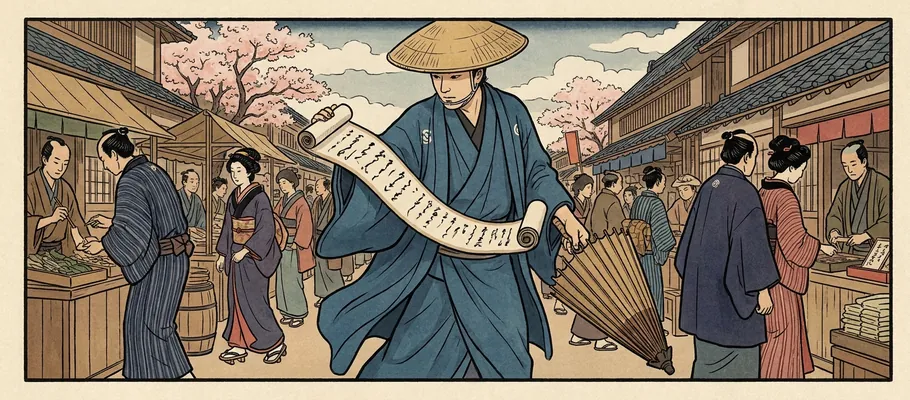
You will encounter this form constantly in everyday life when talking about multitasking, such as eating while watching TV, walking while talking, or listening to music while studying.
Conjugating verbs into the ながら form is straightforward. You simply take the verb stem (often called the masu-stem) and attach
To find the stem, change the verb to its formal
For verbs ending in
| Dictionary Form | Stem | ながら Form | Meaning |
|---|---|---|---|
| While eating | |||
| While watching | |||
| While thinking |
For u-verbs, change the final "u" sound to the corresponding "i" sound, then add
| Dictionary Form | Stem | ながら Form | Meaning |
|---|---|---|---|
| While drinking | |||
| While walking | |||
| While speaking | |||
| While listening |
The irregular verbs follow their standard stem changes.
| Dictionary Form | Stem | ながら Form | Meaning |
|---|---|---|---|
| While doing | |||
| While coming |
While the conjugation is simple, there are three strict rules regarding how sentences are built with ながら.
When using ながら, the action that comes after ながら is the primary focus of the sentence. The action that comes before (the one attached to ながら) is the secondary, supporting action.
If you say "I study while listening to music," your main goal is studying. Listening to music is just background activity. Therefore, "listening to music" takes the ながら form, and "studying" ends the sentence.
If you swapped them and said
You can only use ながら when one person is performing both actions.
You cannot use it to say "While my mother cooked, I watched TV." For situations where two different people are doing different things, you would use structures like
The verb attached to ながら never indicates tense or politeness on its own. Whether the action happened in the past, will happen in the future, or is spoken casually or politely is entirely determined by the final verb of the sentence.
Since both ながら and the te-form can connect verbs, it can sometimes be confusing to know which one to use. For a deeper look at sequential connections, see Connect ideas with the て-Form.
Compare these two sentences:
Sometimes you will see
While regular ながら is primarily used with verbs, ながらも can also attach directly to nouns and adjectives.
This usage is slightly more formal and often appears in fixed expressions (like
The concept of simultaneous actions exists in almost every language, but the Japanese structure forces you to put your main action at the end.
If you find yourself constantly reversing the order (putting the primary action before ながら), don't stress over it too much. When you are speaking on the fly, native speakers will still understand your intent from the context.
Instead of treating the "main action second" rule as a math equation to solve in your head before speaking, rely on A Practical Guide to Language Immersion. The more you listen to native Japanese media, the more you will naturally internalize the rhythm of placing the core action at the end of the sentence.
A fundamental guide to understanding how particles function in Japanese grammar.
Learn how to describe the world with い and な-adjectives by mastering their conjugations for tense and polarity to create rich, descriptive sentences.
Learn how to point out objects, places, and people using the Japanese demonstrative system, based on their distance from the speaker and listener.