
GRAMMAR
Introduction to Japanese Particles
A fundamental guide to understanding how particles function in Japanese grammar.
In English, we mainly use a two-part system to point things out: "this/here" for things close to us, and "that/there" for things further away. Japanese uses a more precise system based on four syllables: こ (Ko), そ (So), あ (A), and ど (Do).
This is universally known as the Ko-So-A-Do system. Understanding how it maps to physical space (or psychological distance) is the key to pointing out anything in Japanese.
Once you memorize these four prefixes, you simply attach different endings to them to talk about objects, locations, directions, or methods.
The most common use of the system is to point at physical objects. To create demonstrative pronouns (standalone words for objects), add れ (re) to the prefixes.
| Word | Meaning | Usage |
|---|---|---|
| This | An object near the speaker | |
| That | An object near the listener | |
| That over there | An object far from both | |
| Which one | Asking to identify an object |
These words function as nouns and can stand completely alone as the subject or object of a sentence.
If you want to say "this book" instead of just "this", you cannot use これ. Instead, you change the ending to の (no). These words function like demonstrative adjectives and must be followed immediately by a noun.
Unlike standard Japanese adjectives, these words do not conjugate. For a full guide on how standard adjectives work, see Introduction to Japanese Adjectives.
| Word | Meaning | Usage |
|---|---|---|
| This [noun] | Modifies a noun near the speaker | |
| That [noun] | Modifies a noun near the listener | |
| That [noun] over there | Modifies a noun far from both | |
| Which [noun] | Asking about a specific noun |
When talking about locations ("here", "there", "where"), add こ (ko) to the prefixes. Note that the "a" version is slightly irregular and becomes あそこ instead of just "あこ".
| Word | Meaning | Usage |
|---|---|---|
| Here | Location near the speaker | |
| There | Location near the listener | |
| Over there | Location far from both | |
| Where | Asking about a location |
For directions ("this way", "that way"), use the っち (cchi) ending for casual speech, or ちら (chira) for formal speech.
Beyond physical directions, these words are frequently used when choosing between two options. For instance, if someone asks you to pick between coffee and tea, you use どっち/どちら to ask "which one (of the two)".
| Casual | Formal | Meaning |
|---|---|---|
| This way / This one (of two) | ||
| That way / That one (of two) | ||
| That way over there | ||
| Which way / Which one (of two) |
To refer to a person ("this person", "that person"), you simply attach the noun
If you want to be polite (for example, introducing someone at work or talking to a customer), use the formal direction words (こちら, そちら) instead.
| Standard | Polite | Meaning |
|---|---|---|
| This person | ||
| That person | ||
| That person over there | ||
| Which person / Who |
The final group describes the way something is done ("in this way", "like that"). Notice that the "A" version has a double "a" sound instead of adding an "u".
| Word | Meaning |
|---|---|
| Like this / In this way | |
| Like that / In that way | |
| Like that over there / In that way | |
| How / In what way |
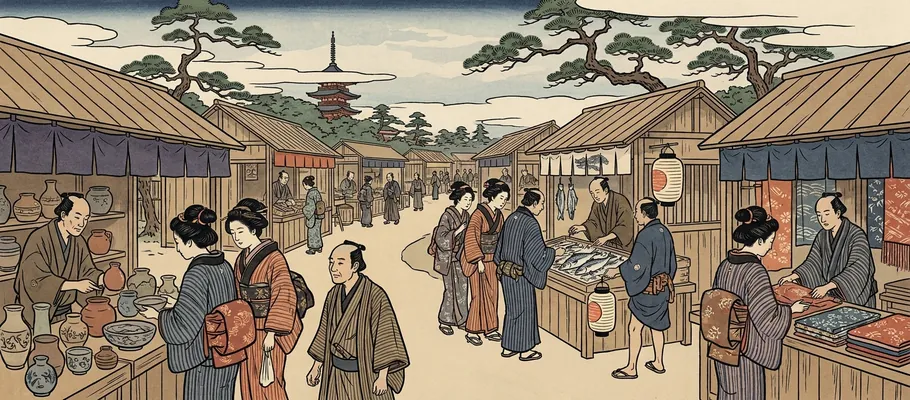
Imagine you are standing at a market stall. Depending on where an object is located relative to you and the merchant, the word you use will change.
Notice how sentences end with
The Ko-So-A-Do system is highly systematic. You do not need to memorize every single word as an individual vocabulary item. Instead, remember the 4 prefixes (こ・そ・あ・ど) and recognize the patterns of the endings.
When you hear a word starting with "そ", you immediately know it has something to do with the listener's space. When you hear "ど", you instantly know a question is being asked.
As you spend more time with the language, adjusting based on spatial relationships will become second nature. Reading and listening are the fastest ways to solidify this framework. For more on learning through exposure, check out our guide on A Practical Guide to Language Immersion.
A fundamental guide to understanding how particles function in Japanese grammar.
Learn how to describe the world with い and な-adjectives by mastering their conjugations for tense and polarity to create rich, descriptive sentences.
Learn how to point out objects, places, and people using the Japanese demonstrative system, based on their distance from the speaker and listener.